Last Updated on 15 October 2026 by Ahsan Khan
If you have recently spotted a pale, wrinkled, pear-shaped gourd at your local market or on a restaurant menu, you are likely asking: what is chayote?
You are not alone. This remarkable ingredient has been a staple in tropical cuisines for centuries, yet it remains a mystery to many. To give you the clearest answer:
Chayote Definition: The chayote (pronounced chy-OH-tay) is a mild, crisp, light-green edible gourd. While botanically classified as a fruit, it is universally prepared and eaten as a vegetable. Scientifically known as Sechium edule, it belongs to the Cucurbitaceae (squash and melon) family and is prized worldwide for its culinary versatility and impressive nutritional profile.
In this comprehensive guide, we will explore the chayote meaning, its fascinating botanical structure, global history, taste profile, and the many ways you can incorporate this remarkable plant into your life.
What is chayote? The Botanical Structure
To truly understand the chayote plant, we must look beyond the kitchen and into the science of botany. This gourd is not just a vegetable — it is a marvel of the plant kingdom with a rich taxonomic identity.
The Taxonomic Classification
Every plant on Earth belongs to a hierarchical classification system. Here is the complete botanical identity of the vegetable pear:
| Taxonomic Rank | Scientific Name | Significance |
|---|---|---|
| Kingdom | Plantae | The entire plant kingdom |
| Clade | Tracheophytes | Vascular plants with specialized transport tissues |
| Clade | Angiosperms | Flowering plants that produce seeds within a fruit |
| Clade | Eudicots | Plants with two embryonic leaves (cotyledons) |
| Clade | Rosids | A major group of eudicots |
| Order | Cucurbitales | The gourd and begonia order |
| Family | Cucurbitaceae | The Gourd Family (squashes, melons, cucumbers) |
| Genus | Sechium | A small genus of only 2 recognized species |
| Species | Sechium edule | The Chayote — the only widely cultivated species |
This classification reveals something fascinating: the chayote belongs to a very small genus (Sechium) containing only two species — Sechium edule (the common chayote) and Sechium compositum (a rare, wild relative with spiny fruit). This makes our common Mirliton a truly unique botanical treasure.
The Botanical Family Tree: Chayote’s Plant Cousins
The vegetable pear is a proud member of the Cucurbitaceae family, one of the most important plant families in human agriculture. This family includes over 900 species across approximately 96 genera. Understanding its botanical relatives helps us appreciate its characteristics.
The Chayote’s Botanical Cousins
| Botanical Name | Common Name | Relationship to Chayote | Shared Characteristics |
|---|---|---|---|
| Sechium edule | Chayote | The subject of this guide | Pear-shaped, mild, crisp, tropical vine |
| Cucumis sativus | Cucumber | Close cousin (same genus family) | High water content, crisp texture, mild flavor |
| Cucumis melo | Cantaloupe / Muskmelon | Cousin | Sweet aromatic varieties, trailing vine |
| Cucurbita pepo | Zucchini / Summer Squash | Close cousin | Similar culinary uses, soft edible skin |
| Cucurbita moschata | Butternut Squash / Pumpkin | Cousin | Starchy flesh, versatile cooking applications |
| Citrullus lanatus | Watermelon | Distant cousin | High water content, trailing vine habit |
| Lagenaria siceraria | Bottle Gourd (Calabash) | Cousin | Similar vine structure, edible when young |
| Luffa cylindrica | Sponge Gourd (Loofah) | Cousin | Fibrous texture when mature, edible when young |
| Benincasa hispida | Winter Melon (Ash Gourd) | Cousin | Mild flavor, used in Asian soups |
| Momordica charantia | Bitter Melon | Cousin | Bitter profile, medicinal uses in Asia |
| Cyclanthera pedata | Caigua (Slipper Gourd) | Distant cousin | Hollow fruit, used in Andean cuisine |
| Trichosanthes cucumerina | Snake Gourd | Cousin | Elongated fruit, popular in Indian cooking |
What Makes Chayote Unique in Its Family?
While the Mirliton shares the trailing vine habit, broad leaves, and tendril-bearing stems typical of the Cucurbitaceae family, it has one extraordinary feature that sets it apart: vivipary. Unlike most gourds where you plant dry seeds, the chayote’s single seed germinates while still inside the fruit. The entire fruit must be planted whole, with the sprouting seed sending roots into the soil. This makes it one of the few “live-bearing” fruits in the entire plant kingdom.
Is Chayote a Fruit or Vegetable?
To truly understand the chayote fruit, we must look at it through two different lenses: science and the kitchen.
- The Botanical Truth: Scientifically, the Mirliton (Sechium edule) is a fruit. Specifically, it is a type of berry. Why? Because it develops from the flower of the plant and envelops a single, large, edible seed in its center.
- The Culinary Reality: In global gastronomy, it is treated strictly as a chayote vegetable. Because it has very low sugar content, high water content, and a starchy, savory profile, it is cooked and seasoned exactly like zucchini, potatoes, or summer squash.
Whether you call it a fruit or a vegetable, its mild nature makes it the ultimate culinary blank canvas.
What Does Chayote Taste Like?
One of the most common questions among new buyers is: what does chayote taste like?
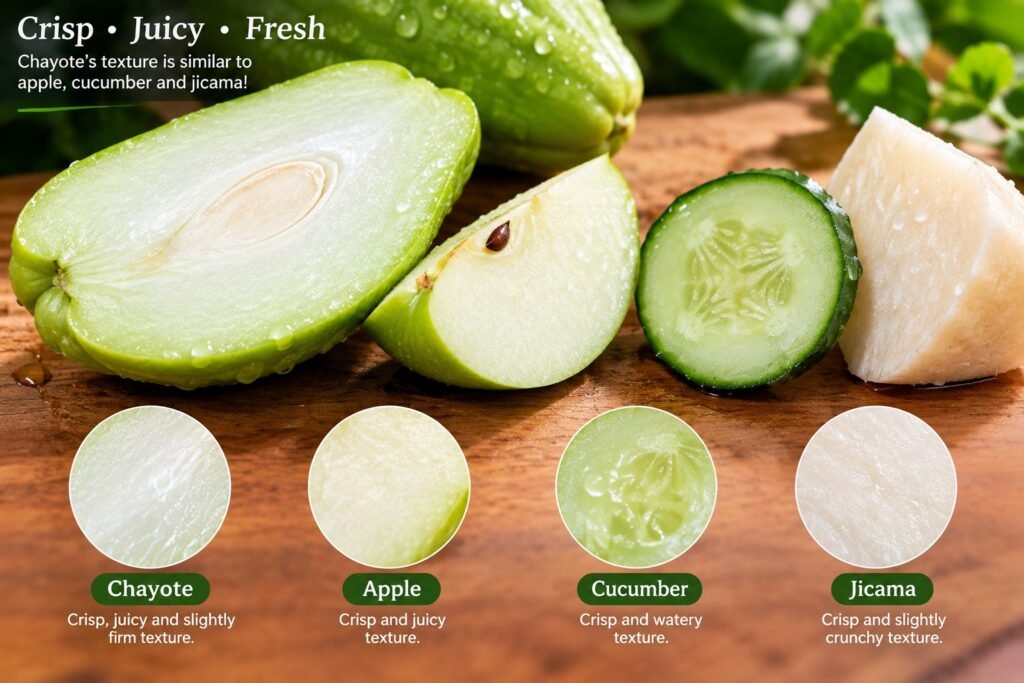
The flavor profile of the chayote vegetable is incredibly subtle and approachable.
- Flavor: It has a very mild, slightly sweet, and refreshing taste. Most food enthusiasts describe it as a cross between a crisp cucumber, a mild green apple, and a delicate summer squash.
- Texture: When raw, the flesh is juicy and crunchy, very similar to jicama or water chestnuts. When cooked, it softens beautifully while maintaining a slight bite, acting like a sponge that absorbs the rich flavors of broths, garlic, spices, and sauces.
- The Seed: The single, large, flattened seed in the center is completely edible. It has a slightly nuttier flavor than the flesh and a texture similar to a cooked macadamia nut or almond.
How to Cook Chayote: Methods and Global Culinary Uses
Because of its neutral flavor, learning how to cook Mirliton opens up a world of culinary possibilities. Here are the most popular methods for preparing this versatile gourd:
- Raw (Salads & Slaws): The refreshing crunch of raw vegetable pear transforms it into an ideal addition to vibrant salads and slaws. Julienne the flesh and toss it with lime juice, cilantro, and chili for a refreshing Latin-style slaw.
- Sautéed or Stir-Fried: Sliced thinly, it cooks quickly in a hot pan. It pairs beautifully with garlic, olive oil, and lean proteins.
- Roasted or Grilled: Tossed with root vegetables, the Mirliton caramelizes slightly in the oven, bringing out its natural, subtle sweetness.
- Boiled or Steamed: Often added to hearty soups, stews, and traditional bone broths to add bulk and nutrients without overpowering the dish.
- Stuffed: Halved and hollowed out, the shells make excellent “boats” for ground meats, cheeses, and breadcrumbs.
Global Cuisine Relations
The Mirliton has been embraced by cuisines worldwide, each preparing it in culturally distinct ways:
| Cuisine | Traditional Preparation | Signature Dish |
|---|---|---|
| Mexican | Boiled, sautéed with herbs | Calabacitas (with corn, zucchini, and epazote) |
| Caribbean | Stewed with coconut milk | Christophine au gratin (baked with cheese sauce) |
| Brazilian | Sautéed with garlic and onions | Refogado de chuchu (a classic side dish) |
| Louisiana Creole | Stuffed with seafood | Mirliton stuffed with shrimp |
| Vietnamese | Stir-fried or in soups | Su su xao (stir-fried with garlic) |
| Korean | Pickled or in soups | Bok choy substitute in temple cuisine |
| Filipino | Added to stews | Tinola (chicken soup with chayote and ginger) |
Looking for exact measurements and step-by-step instructions? Explore our dedicated guide featuring the best [chayote recipes] for your next family dinner!
The Global Journey: Etymology and Regional Names
The chayote meaning is deeply rooted in indigenous history. The word itself is derived from the Nahuatl (Aztec) word chayotli, which translates roughly to “thorny squash.”
Hailing from the heart of Mesoamerica (modern-day Mexico and Central America), the chayote plant was cultivated by indigenous civilizations long before Europeans arrived. As explorers and traders carried the seeds across the globe, the vegetable adapted to new cultures and acquired a fascinating array of aliases:
| Regional Name | Primary Region | Description / Context |
|---|---|---|
| Chayote | Mexico, Central America | The original, globally recognized Nahuatl-derived name. |
| Christophine | Caribbean | Widely used in the West Indies and Caribbean cooking. |
| Xuxu / Chuchu | Brazil, Portugal | The standard Brazilian term, heavily featured in local stews. |
| Guatila | Colombia / Dominican Republic | A common term in parts of South America and the Caribbean. |
| Choko | Australia, New Zealand | The everyday grocery store name in Oceania. |
| Mirliton | Louisiana, USA | A staple of Creole cuisine, often stuffed with seafood. |
| Vegetable Pear | Southern USA | A descriptive name referencing its shape and pale color. |
| Sayote | Philippines | The local adaptation of the Nahuatl name. |
| Sechium edule | Global / Scientific | The official botanical name used by researchers and botanists. |
Understanding these diverse names helps us appreciate the rich cultural background and global significance of this remarkable chayote fruit.
The Chayote Plant: A Gardener’s Dream
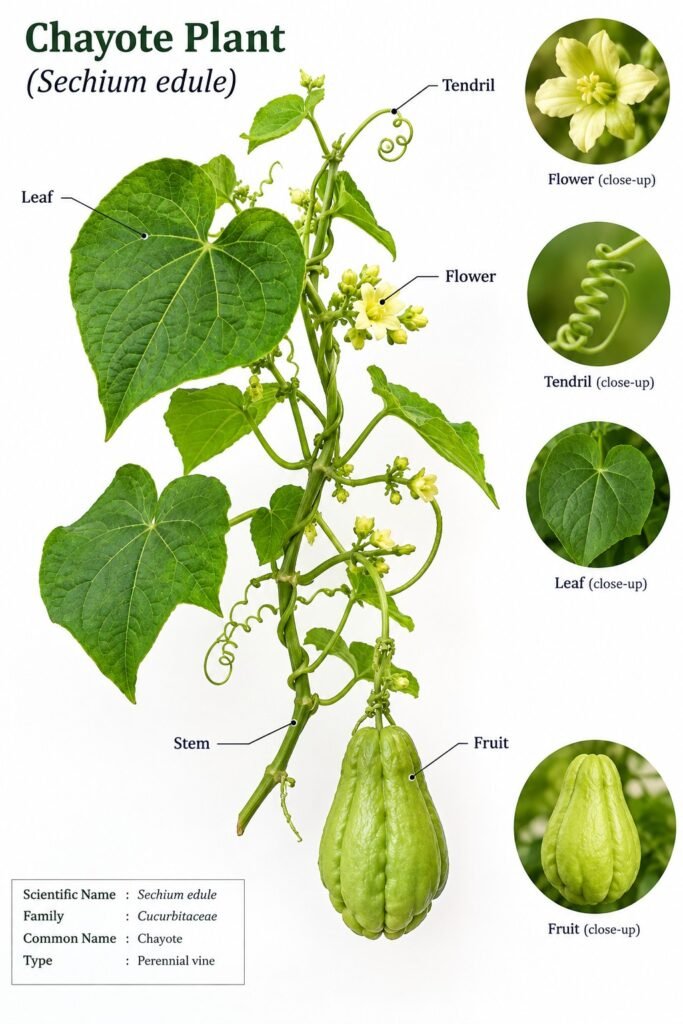
Beyond the kitchen, the chayote plant (Sechium edule) is a marvel of the botanical world. It is a vigorous, climbing perennial vine that can grow up to 30 feet in a single season if given a sturdy trellis.
Plant Structure Breakdown
- Root System: A large, tuberous root system that stores energy and allows the plant to survive mild winters and regrow year after year.
- Vines: Long, trailing stems with tendrils that cling to supports.
- Leaves: Broad, heart-shaped, dark green leaves with slightly fuzzy texture.
- Flowers: Small, pale yellow to white, unisexual flowers (both male and female on the same plant).
- Fruit: The edible pear-shaped gourd, typically 3-6 inches long, with smooth or slightly grooved skin.
- Seed: A single, large, flattened, pale seed that germinates inside the fruit (vivipary).
Unlike most squashes where you plant a seed from the inside of the fruit, the entire chayote fruit is planted whole. The seed inside actually germinates inside the fruit, and the whole gourd is buried halfway in the soil. The plant thrives in warm, tropical, and subtropical climates, producing beautiful, delicate vines and high yields of fruit, making it a favorite for sustainable, home-garden permaculture.
Can Dogs Eat Chayote?
A frequent question from health-conscious pet owners is: can dogs eat vegetable pear?
The short answer is YES.
The vegetable pear is non-toxic and generally safe for dogs to consume. In fact, because it is low in calories, high in water, and packed with dietary fiber and vitamin C, it can be a healthy, crunchy treat for dogs needing to manage their weight.
Important Precautions for Pets:
- Always cook it: Raw chayote can be tough and difficult for a dog’s digestive system to break down. Lightly steaming or boiling it (without any salt, garlic, or onions) makes it much easier for them to digest.
- Remove the seed: While the seed is edible for humans, it can pose a choking hazard or cause intestinal blockage in smaller dogs. Always scoop it out before serving it to your furry friend.
- Serve in moderation: Introduce any new high-fiber food slowly to avoid upsetting your dog’s stomach.
(Note: Always consult your veterinarian before introducing new human foods into your pet’s diet.)
FAQ’S
What is a Mirliton?
Mirliton is a unique squash-like vegetable from the gourd family. It comes from Mexico and Central America. People in Latin America have loved it for centuries.
Where does chayote come from?
Mirliton originates from Mesoamerica (modern-day Mexico and Central America). It was first cultivated by indigenous civilizations long before European arrival and has since spread to tropical and subtropical regions globally.
What are the different names for chayote?
Chayote is known by many names worldwide. These include christophine, xuxu, chuchu, Mirliton, guatila, choko, and the Mexican pear. These names show how popular and diverse this vegetable is.
Is chayote good for you?
Yes! It is highly nutritious, offering a rich source of folate, vitamin C, and dietary fiber while being exceptionally low in calories. (Want to know exactly how it supports your body? Read our full guide on the [Amazing Chayote Squash Benefits].)
Is chayote a starch?
No, the Mirliton is a non-starchy vegetable. Unlike potatoes or corn, it is very low in carbohydrates and calories, making it an excellent substitute for higher-starch ingredients in low-carb or keto diets.
Can you eat the seed inside the chayote?
Yes! The single, large, flattened seed in the center of the chayote fruit is completely edible. It has a slightly nuttier flavor than the flesh and a texture similar to a cooked macadamia nut or almond. You can chop it up and cook it right along with the rest of the vegetable.
What is chayote in English?
In English, it is most commonly just called “chayote,” but it is also frequently referred to as the “vegetable pear,” “mirliton” (in the South), or “choko” in certain regions. Scientifically, it is known as Sechium edule.
Do you peel chayote before cooking?
While the skin of very young, tender vegetable pear is edible, it is highly recommended to peel it. More importantly, the raw sap just beneath the skin can cause a temporary tingling or drying sensation on human hands. Pro Tip: Peel it under running water or wear kitchen gloves to avoid the sap!
The Bottom Line
The vegetable pear is far more than just a quirky-looking gourd. From its ancient roots as Sechium edule in Mesoamerica to its status as a global culinary staple, this versatile chayote vegetable offers a mild flavor, a fantastic crunch, and a world of cooking possibilities.
Whether you are a botanist fascinated by its unique viviparous seed, a gardener looking for a productive perennial vine, a chef seeking a versatile canvas for flavors, or a pet owner searching for a healthy dog treat — this plant has something for everyone. By understanding its botanical family, its global culinary journey, and its remarkable characteristics, we can truly appreciate the chayote meaning in all its dimensions.
References: