

TDEE & Macro Calculator – Daily Calorie & Protein Targets
TDEE & Macro Calculator
Calculate your Total Daily Energy Expenditure and ideal protein, carb, and fat split.
How to Use Your TDEE Results for Weight Loss, Health, and Muscle Gain
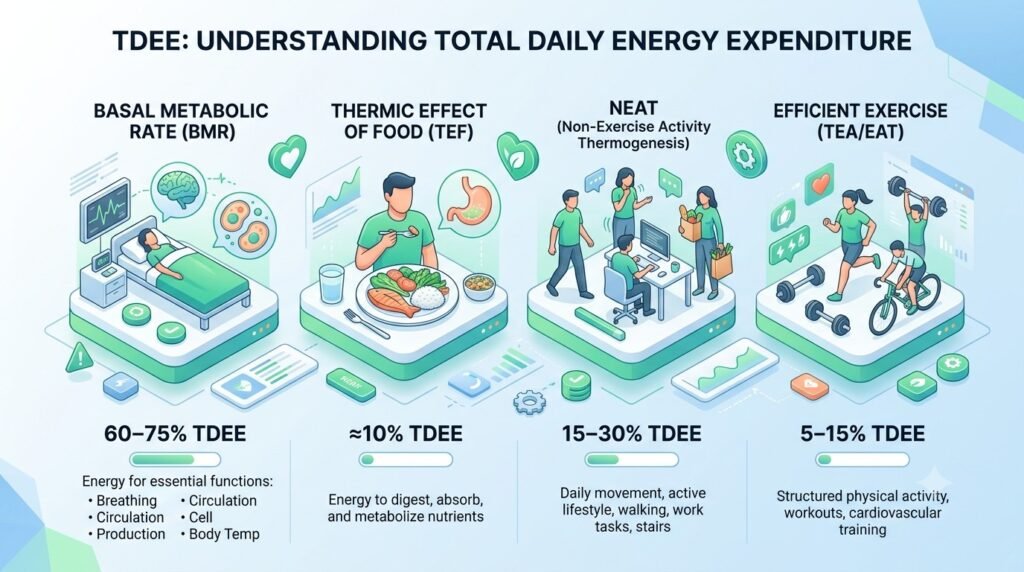
Understanding your energy expenditure is the most vital step in reaching any metabolic or fitness goal. While many standard calculators provide generic figures, computing your precise Total Daily Energy Expenditure (TDEE) gives you an actionable baseline grounded in clinical energy-balance science.
Whether your target is shedding body fat, maintaining your current composition, or building lean muscle tissue, this guide explains how your daily caloric burn is structured and how to optimize your outcome.
What is Total Daily Energy Expenditure (TDEE)?

Total Daily Energy Expenditure (TDEE) represents the total number of calories your body burns in a 24-hour period. It combines your baseline metabolic function with every physical movement you perform throughout the day—from intensive weight training to breathing and fidgeting.
Your TDEE is determined by four key components:
- Basal Metabolic Rate (BMR) (~60–70% of total burn): The energy your organ systems consume simply to keep you alive while at complete rest.
- Thermic Effect of Food (TEF) (~10% of total burn): The caloric cost of digesting, absorbing, and processing nutrients. Protein requires the highest metabolic energy to digest (~20–30% of its calories).
- Non-Exercise Activity Thermogenesis (NEAT) (~15% of total burn): Calories burned through non-deliberate daily movement, such as walking, cleaning, cooking, and posture maintenance.
- Exercise Activity Thermogenesis (EAT) (~5–10% of total burn): Calories burned during intentional, structured physical training (cardio, resistance exercises, sports).
TDEE vs. BMR: What Is the Difference?
A common mistake in nutritional planning is confusing BMR with TDEE:
- Basal Metabolic Rate (BMR) is the baseline energy needed if you were to stay in bed all day without moving. Eating below your BMR for extended periods can slow your biological processes and cause unnecessary fatigue.
- TDEE multiplies your BMR by an activity factor to reflect your actual daily lifestyle. This reflects the total number of calories needed to maintain your weight.
Before setting your caloric goals, it is also helpful to establish your baseline weight classification using our [interactive BMI calculator]
Key Rule: Always base your weight targets (caloric deficit or surplus) on your TDEE, not your standard BMR.
How to Adjust Your Calories Based on Your Goals
Once you calculate your baseline TDEE, apply these evidence-based calorie targets:
1. Sustainable Fat Loss (Moderate Deficit)
- Goal: Lose 0.5 to 1.5 lbs of fat per week without sacrificing lean muscle.
- Adjustment: Subtract 300 to 500 calories from your baseline TDEE.
- Example: If your TDEE is 2,300 kcal/day, set your weight loss target to 1,800 kcal/day.
2. Gaining Lean Muscle Without Excessive Fat
- Goal: Build muscle while minimizing fat accumulation.
- Adjustment: Add 250 to 300 calories above your baseline TDEE.
- Example: If your TDEE is 2,200 kcal/day, set your muscle-building target to 2,450 kcal/day.
3. Metabolic Maintenance & Recomposition
- Goal: Keep your current body weight steady while building muscle, trimming fat, and boosting daily energy.
- Adjustment: Eat directly at your estimated TDEE while maintaining consistent resistance exercise.
Understanding Your Macronutrient Distribution

Calories determine weight change, but macronutrients (protein, carbohydrates, and fats) determine body composition and metabolic health.
- Protein (4 calories per gram): Crucial for repairing muscle tissues, preserving lean mass during weight loss, and regulating appetite hormones. Aim for 0.7–1.0 grams per pound of body weight when active.
- Carbohydrates (4 calories per gram): Your primary energy source for high-intensity movement, brain function, and cellular energy recovery.
- Fats (9 calories per gram): Essential for hormone production (including thyroid and reproductive hormones), cell membrane integrity, and nutrient absorption. Keep fats at 20–35% of total intake.
FAQ’s
How accurate is this TDEE calculator?
Our calculator uses the Mifflin-St Jeor formula, which was validated in a [published study in the American Journal of Clinical Nutrition] as the most accurate equation for predicting basal metabolic rate in healthy individuals.
Why am I not losing weight eating below my calculated TDEE?
If weight loss stalls, common factors include underestimating daily food intake, overestimating workout intensity, fluid retention from stress/cortisol, or a drop-in non-exercise activity (NEAT). Track food consistently for 14 days and adjust your targets by 100–150 calories if necessary.
How often should I recalculate my TDEE?
Recalculate your TDEE every time you lose or gain 5 to 10 pounds, or whenever your daily movement patterns change significantly (such as changing jobs or starting a new exercise program).
Next Steps for Your Health Journey.
- Check your overall weight classification with our BMI Calculator.
- Discover natural functional botanicals that support healthy digestion and stress management in our Herb Synergy Calculator.